 RichScripts
Food Ingredient Checker
Know what's in your food before it's in your basket. Paste a list, snap the label or type a barcode, and see allergens, additives and sugars in seconds.
- 14 major allergens and their other names
- Every common E-number, explained
- Reads 6 languages, including bilingual packs
- Private: checked in your browser, no account

What's in it
Paste an ingredient list to get started.
Your breakdown appears here
- Allergens, with the words that matched
- "May contain" warnings
- Additives and E-numbers, explained
- Sugars, palm oil, vegan and vegetarian
How it works
- 1
Add the ingredients
Paste the list, scan the label with your phone camera, or look the product up by barcode.
- 2
We read every word
Each ingredient is matched against allergen names, E-numbers, sugars and animal-derived ingredients, in six languages.
- 3
See what matters to you
Tick the allergens you avoid and get a clear warning when a product contains them, or may contain them.

Spots allergens by any name
Labels rarely say "milk" when they can say whey, casein or lactose. The checker knows the other names for the EU's 14 major allergens and the US major nine, and keeps "may contain" warnings separate from real ingredients.
See the 14 allergens and their other names →
- Gluten
- Milk
- Eggs
- Peanuts
- Tree nuts
- Soybeans
- Fish
- Crustaceans
- Molluscs
- Sesame
- Celery
- Mustard
- Lupin
- Sulphites

Reads the label, whatever the language
Bought something abroad, or have a bilingual pack? French, German, Spanish, Italian and Dutch labels are read with their own word lists, including German and Dutch compound words.
- EN wheat flour
- FR farine de blé
- DE Weizenmehl
- ES harina de trigo
- IT farina di frumento
- NL tarwebloem
Every one of those is recognised as wheat, a gluten source.
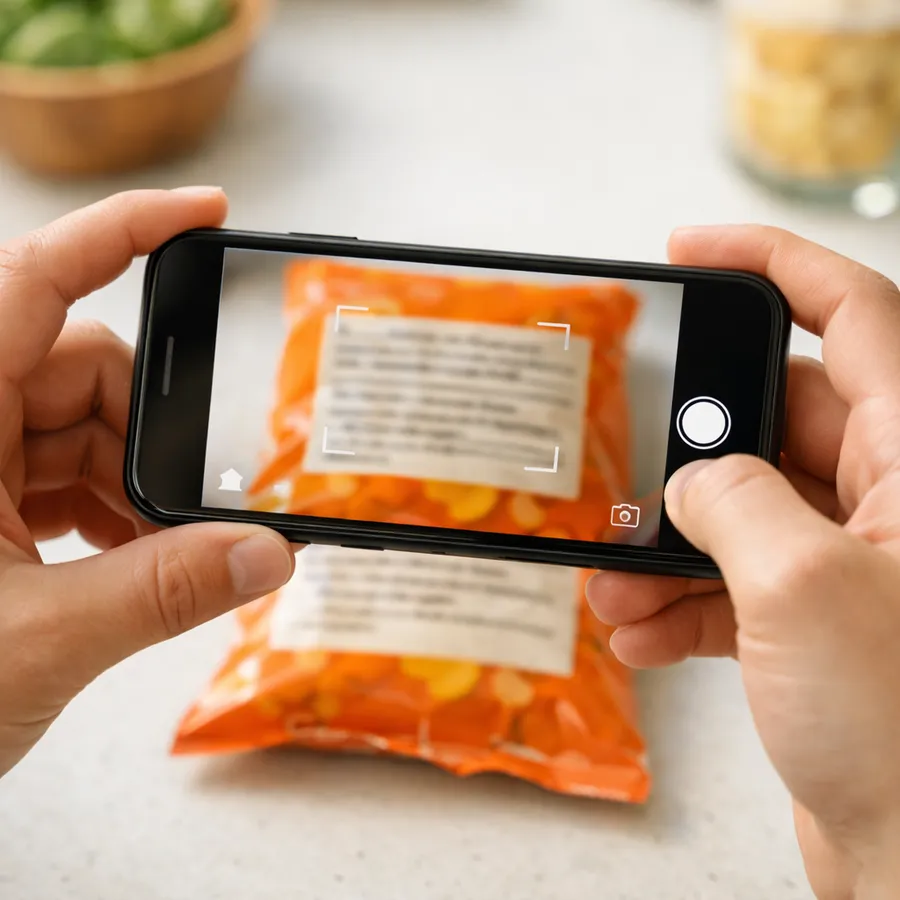
Point, shoot, check
Open this page on your phone, choose Scan photo and take a picture of the ingredient panel. Text recognition runs on your device, so the photo never leaves it. If a word may have been misread, such as "sya" for soya, the checker flags it so you can check the pack.
How this tool works
The checker splits the list into ingredients, keeping sub-ingredients in brackets together, and matches each word against lists of allergens, additives, sugars and animal-derived ingredients. Allergens follow the 14 that EU and UK labelling rules require, plus the US major nine, and include their other names: whey, casein and lactose all mean milk, for example. Matching is deliberately cautious, so it may flag something that turns out to be fine rather than miss a real allergen. Additives are found by E-number (or INS number) and by name, and shown with their purpose. French, German, Spanish, Italian and Dutch labels are read with their own word lists, including German and Dutch compound words such as Weizenmehl and tarwebloem (both wheat flour), so bilingual packs work too. Photos are read by text recognition in your browser; check the recognised text against the pack, because small print and shiny packaging can cause misread words. "May contain" statements are reported separately, because they describe possible traces rather than ingredients. The check reads words only: it cannot see how a food was made, and it does not score foods as healthy or unhealthy.
How do I check food ingredients for allergens?
Paste the ingredient list from the pack, or enter the barcode number, and press Check ingredients. The checker highlights the EU's 14 major allergens and the US major nine, including their other names such as whey or casein for milk. Always read the pack as well, where allergens are usually shown in bold.
What are E-numbers?
E-numbers are codes for food additives approved in the European Union, such as E330 for citric acid or E211 for sodium benzoate. Other countries use the same numbers without the E, called INS numbers. The checker lists each additive's name and purpose; see the full E-numbers list for what each code means.
What does "may contain" mean on a food label?
It is a precautionary statement: the allergen is not an ingredient, but the food may have come into contact with it during production. People with severe allergies are usually advised to avoid these products.
How can I tell if a food is vegan?
Look for animal-derived ingredients such as milk, whey, eggs, honey, gelatine and insect-based colours like carmine (E120). Some ingredients, such as vitamin D3 or L-cysteine (E920), can come from animal or non-animal sources, so check with the maker.
Which languages can it read?
English, French, German, Spanish, Italian and Dutch. It recognises allergens, additives, sugars and animal-derived ingredients in each language, including "may contain" statements such as peut contenir, kann Spuren enthalten, puede contener, può contenere and kan sporen bevatten. E-numbers are the same in every language.
Are ingredients listed in order?
Yes. In the EU, UK, US, Canada and Australia, ingredients are listed in descending order by weight, so the first few ingredients make up most of the food.
Is my information stored?
The check runs in your browser and the ingredient list is not sent to our server. A barcode lookup sends only the barcode number to Open Food Facts. Photos are read in your browser and are not uploaded; the text reader and its language file are downloaded from a public code library the first time you scan. The allergens you choose to avoid are saved in this browser only.
This tool is for information only and is not medical or dietary advice. Recipes change, so always read the label on the pack you are buying, and contact the manufacturer if you are unsure.
References: UK Food Standards Agency allergen guidance · US FDA food allergies · EU food additives database